Your First Classes and Objects · practice
What self Refers To
The Question class now uses self in both __init__ and is_correct. We have relied on it several times, so this lesson slows down to examine exactly what it refers to.
self is a
Consider two questions:
first = Question("Two plus two?", "4")
second = Question("Three plus three?", "6")

first.is_correct("4")
second.is_correct("4")
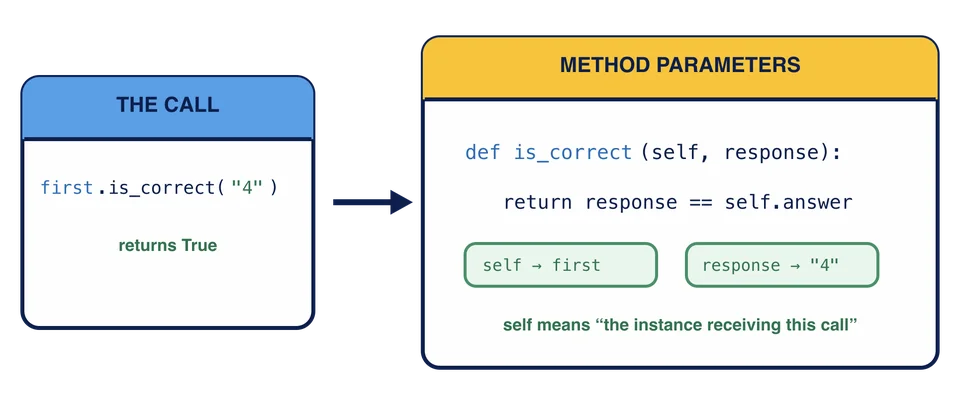
During the first call, self refers to first. During the second call, self refers to second.
Python behaves roughly as if the calls were written like this:
Question.is_correct(first, "4")
Question.is_correct(second, "4")
You will normally use the clearer instance form. The expanded form reveals where self comes from.
The name is a convention with a purpose
Python does not reserve the word self, but Python programmers use it consistently. Keeping that convention makes method definitions readable to everyone.
Inside a method:
self.answermeans theanswerattribute on the current instance;self.promptmeans thepromptattribute on the current instance;another method call can use
self.some_method().
What does this print?
class Label:
    def __init__(self, text):
        self.text = text

    def show(self):
        print(self.text)

first = Label("A")
second = Label("B")
first.show()
second.show()The important idea is not that every self. It does not. self is a method parameter that temporarily refers to the instance receiving that particular call.
Task
Complete answer_length so it returns the length of the current question’s answer.
Then use Step in the exercise editor. Follow the calls for first and second. In each self.answer with the len.
If the