Dictionaries and Other Collections · practice
Search a List of Records
A catalog is useful when a program can find one record by a field.
catalog = [
    {"title": "Kindred", "year": 1979},
    {"title": "Dune", "year": 1965},
]
You cannot ask the "Dune" as a key. The list holds
for item in catalog:
    if item["title"] == "Dune":
        print(item)
Put the search in a function
A search
def find_by_title(catalog, query):
    for item in catalog:
        if item["title"] == query:
            return item

    return None
If a title matches, the first
If the return None. None makes “no matching record” explicit.
Chapter 8 already showed that return ends the current function call and that a function without a useful result produces None. Here, that behavior becomes part of a search contract:
a match returns a dictionary;
no match returns
None.
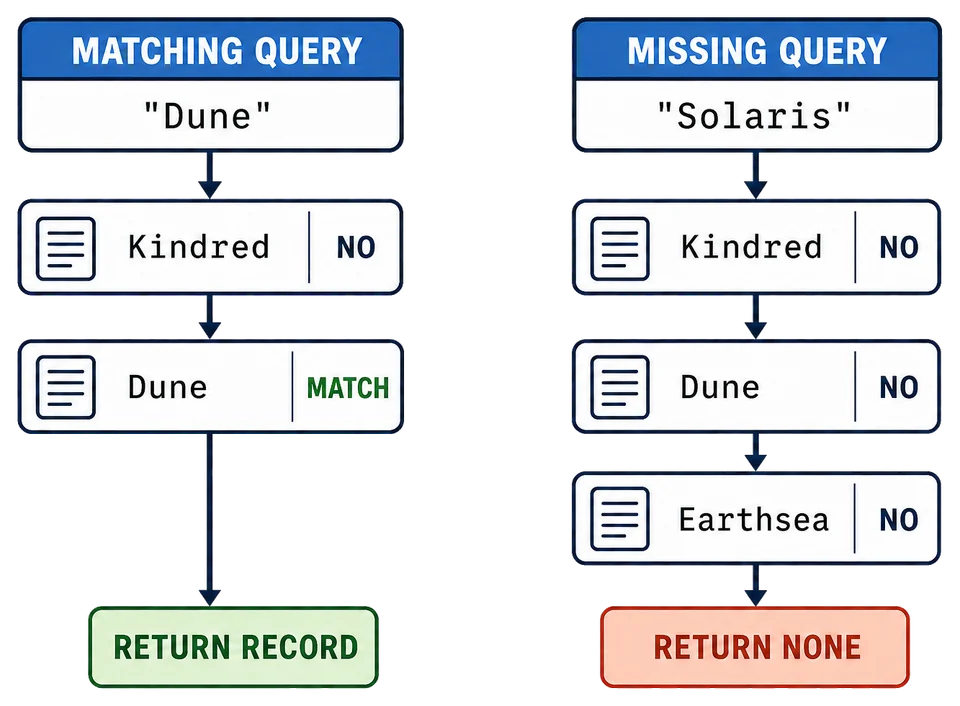
The two paths below show why the final return None belongs after the loop: a match exits early, while a missing query must inspect every record first.
Clean both sides
People may type different capitalization or surrounding spaces. Clean the query once:
clean_query = query.strip().lower()
Put that cleaning into the complete function and compare it with a lowercase version of each stored title:
def find_by_title(catalog, query):
    clean_query = query.strip().lower()

    for item in catalog:
        if item["title"].lower() == clean_query:
            return item

    return None
The original title in the dictionary stays unchanged.
Check the result
Use is not None when a match was found:
match = find_by_title(catalog, "  DUNE ")

if match is not None:
    print(match["year"])
else:
    print("No matching title.")
is None and is not None are the standard checks for this one special
What does match contain?
def find_by_name(records, query):
    for record in records:
        if record["name"].lower() == query.strip().lower():
            return record
    return None

places = [
    {"name": "Kyoto", "country": "Japan"},
    {"name": "Lima", "country": "Peru"},
]

match = find_by_name(places, " lima ")
Task
Complete find_by_title(catalog, query).
The
clean
querywith.strip().lower();through the records in catalog;compare the cleaned query with each lowercase title;
return the matching dictionary immediately;
return
Noneafter the loop if nothing matched.
Keep the existing call and result check.
Expected output:
Found: Dune (1965)
The grader also calls your function with another title and with a missing title.