Where Python Is Strong
Train and Use AI Models
A support team is drowning in messages. Some are about billing, some about delivery, some about getting back into an account. They want software to suggest a topic for each new one as it arrives.
This is a reasonable job for AI, and a good way to see that “using AI” is really a sequence of decisions, most of them made by people.
What a model actually is
An AI model is a system that has learned patterns from examples and can produce a prediction or a generated result for something it has not seen before.
Here, the examples would be old messages already paired with topics such as billing or delivery. The model learns patterns in those pairings and then offers a topic for a new message.
That offer is not a fact. The model can misread a message, faithfully reproduce a bias in the examples it learned from, or quietly degrade when the real messages start changing. Which is why the middle of this process is checking rather than training.
The path, and where the arithmetic happens
The diagram answers two questions at once: which stage is the team at, and where do the large numerical calculations actually run?
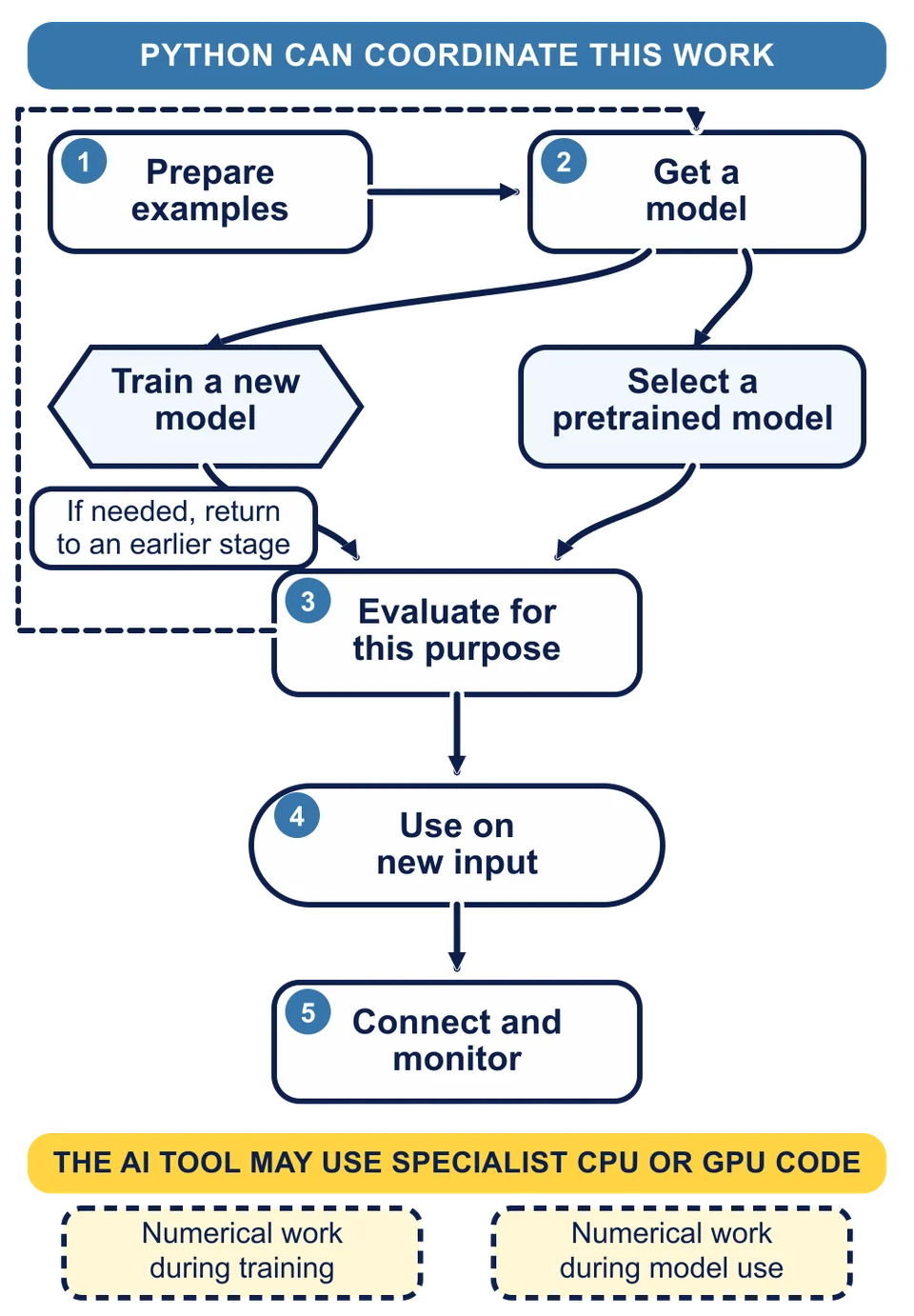
It starts with prepared examples, and that stage inherits everything from the last lesson. A powerful model cannot repair examples that were badly chosen or misunderstood, and somebody needs to know where the data came from and whether they are allowed to use it.
Then a fork. The team can train a model, meaning adjust it with examples until it picks up useful patterns. Training a large model from scratch can demand enormous amounts of data, expertise, computing time, and money; smaller models can be much less demanding. Or the team can take a pretrained model somebody else already trained and check it against its own messages. “We use AI” tells you nothing about which path happened, or whether they are sending requests to a model somebody else runs.
Both paths go through evaluation before anything reaches a customer. To evaluate a model is to check how it behaves on suitable data it was not trained on. One number is rarely enough: a model can handle common delivery questions well and rare account problems badly, or work in one language and not another. The cost of being wrong depends entirely on what happens next.
Evaluation frequently sends the team backwards, which is what the return arrow is for. Real AI work is not one clean trip from left to right.
After that the model gets used, which is often called inference and means, in plain language, using it. A message goes in, a suggested topic comes out, and a support worker who can accept or override it stays in the loop. Then the team watches what happens in production, because new kinds of message appear, costs shift, and mistakes have a habit of concentrating in one group of people.
The band along the bottom of the diagram is the part that surprises people. In tools such as
So why is Python everywhere in AI?
That is the fair question. If ordinary Python is not fast at arithmetic, why does it dominate a field built on arithmetic?
Because Python can direct the arithmetic without performing every step as ordinary Python instructions. It prepares the information, describes the work, calls the framework, inspects what came back, evaluates the behavior, and wires the result into a product. PyTorch and TensorFlow hand supported heavy operations to code built for speed.
Python is the place where people coordinate, and coordination is most of the job. That is why AI training and use are a strong fit, and the honest reason is not that Python itself is fast. The libraries that are connected to it are, though!
The library does not make the decisions
Whether the data is suitable, what the
A model that sorts music recommendations and a model that supports a medical decision do not carry the same risk, and no library knows the difference. People choose the evidence, the checks, the limits, and how much human control to keep.
Python’s role in AI is real and large. It is also more modest than the marketing suggests: it is the accessible place where data, tools, evaluation, and a product get connected. The last lesson of this chapter asks why that same role keeps appearing in field after field.
Go deeper
The Hugging Face Transformers quick tour shows using a pretrained model and training one as separate paths, and PyTorch’s C++ overview explains how its Python and